
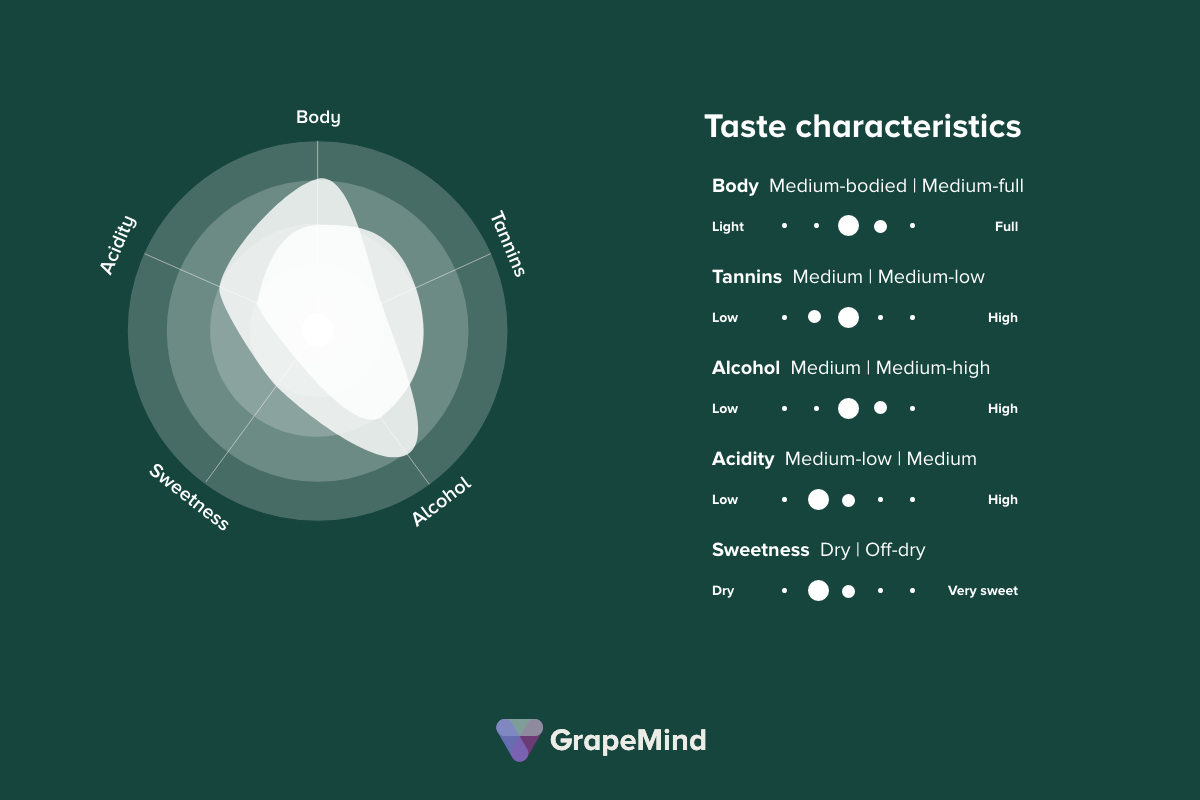
As a perceptive wine drinker, your preference often sways towards wines that offer a gratifying, relaxed sipping encounter. You seek out wines that envelop your palate with well-rounded flavours and a silky texture. You appreciate wines that master the art of equilibrium, not allowing flavour, alcohol, or acidity to take center stage, but rather, ensuring they harmoniously share the limelight. Your refined palate appreciates just the right whisper of tannins, contributing to the perfect balance you so desire in your glass of wine.
Grape suggestions
Let us present to you a selection of grape varieties, known for their propensity to yield wines that are remarkably well-balanced, not too potent, and provide a smoother sensation on the palate.

The common thread amongst these grapes is their uncanny ability to hit the palate just right – they’re neither excessively light nor unduly heavy. The tannin profile of these varieties usually hovers around medium to medium-low, providing a perfect balance to their inherent sweetness and bitterness, thereby crafting a more well-rounded and agreeable wine. Remember though, the final taste of a wine is a delightful cocktail of the grape’s growing location, local climate, and undoubtedly, the winemaking process. This means a Pinot Noir from Burgundy in France will offer a markedly different taste from its counterpart in Germany, where it’s fondly known as Spätburgunder.
Embrace the exciting diversity these grape varieties bring to the table. The ‘just right’ balance they offer, avoiding the extremes of being too light or too heavy, makes them a delightful addition to your wine repertoire. After all, part of the wine tasting adventure is the delightful unpredictability, don’t you think?
Perceptives, wine traits & grapes
Body
In the lexicon of wine, “body” signifies the richness or heft a wine imparts on your palate – an impression that’s frequently linked with the wine’s alcohol level and the perceived viscosity or lushness of the wine. If you identify with the perceptive sect of wine drinkers, medium-bodied wines may be your go-to. Grapes such as Grenache, Sangiovese, and Valpolicella blend for the reds, and Chardonnay, Viognier, and Gewürztraminer for whites, strike a delicate equilibrium between flavour and alcohol content, culminating in a body that’s perfectly mid-weight.
Tannins
As a perceptive, you might be inclined to avoid wines that are excessively tannic. Tannins are naturally occurring compounds in numerous plants, including grapes, and are predominantly found in the grape’s skins, seeds, and stems. They join the wine party during the winemaking process, particularly throughout fermentation and aging. Tannins gift color, texture, and flavor to the wine, often bestowing a hint of bitterness or astringency, which can manifest as a dry sensation on your tongue.
If your palate isn’t partial to tannins, you could find delight in lighter red wines like Pinot Noir, Gamay, or Barbera, and white wines such as Sauvignon Blanc or Pinot Gris. These varieties tend to be lower in tannin content as they have minimal contact with grape skins during the winemaking process.
Alcohol
Perceptive wine drinkers usually veer away from high-alcohol wines, which can seem overwhelming or even generate a warming sensation. Alcohol in wine is birthed during the fermentation process, where yeast transforms grape juice sugar into alcohol and carbon dioxide. The alcohol content is then expressed as a percentage of the wine’s total volume.
Grape varieties that often fall within the medium alcohol spectrum, like Pinot Noir or Grenache for reds and Pinot Grigio or Chenin Blanc for whites, could be apt selections for those who favour moderate alcohol content.
Acidity
Perceptive wine drinkers often favor wines that strike a balance, steering clear of extremes in acidity. Acidity embodies the freshness, tartness, and sour characteristics in a wine, with the primary natural acids being tartaric and malic, and to a lesser degree, citric and lactic acids. These are inherent in grapes and contribute significantly to the wine’s taste, especially lending a sense of sharpness to white wines.
Acidity tickles your palate with a slight tingling sensation on the sides of your tongue and a mouth-watering effect. It’s a pivotal element that can balance the sweetness, bitterness, or tannic traits of a wine, rounding it out to make it more palatable.
White wines like Chardonnay or Viognier, and reds such as Syrah or Sangiovese, typically strike a pleasant level of acidity that neither overpowers nor underplays, leading to a balanced and enjoyable drinking experience.
Sweetness
The sweetness in wine is a product of the residual sugar left in the wake of the fermentation process. During fermentation, yeast feeds on the natural sugars in the grape, transforming them into alcohol. If this process is interrupted prematurely, or if the grapes are naturally sugar-laden, some residual sugar persists, bestowing the wine its sweetness. Sweetness plays a crucial role in balancing a wine’s acidity, bitterness, or tannins, making it more rounded and palatable. It can also enhance the overall body and texture of the wine, yielding a fuller, richer mouthfeel.
In terms of sweetness, perceptive drinkers might be inclined towards wines that aren’t excessively sweet, but instead demonstrate a harmonious balance between sweet and other flavours. These drinkers might enjoy a range of wines, from dry to off-dry, as long as the sweetness is well-integrated and enhances the other characteristics of the wine.
Are you Tolerant, Perceptive or Sensitive?
 GrapeMind